AI Employees for Manufacturing: Five Workflows Worth Automating
Manufacturing teams can automate preparation and coordination while technical, pricing, quality, and delivery commitments remain with specialists.
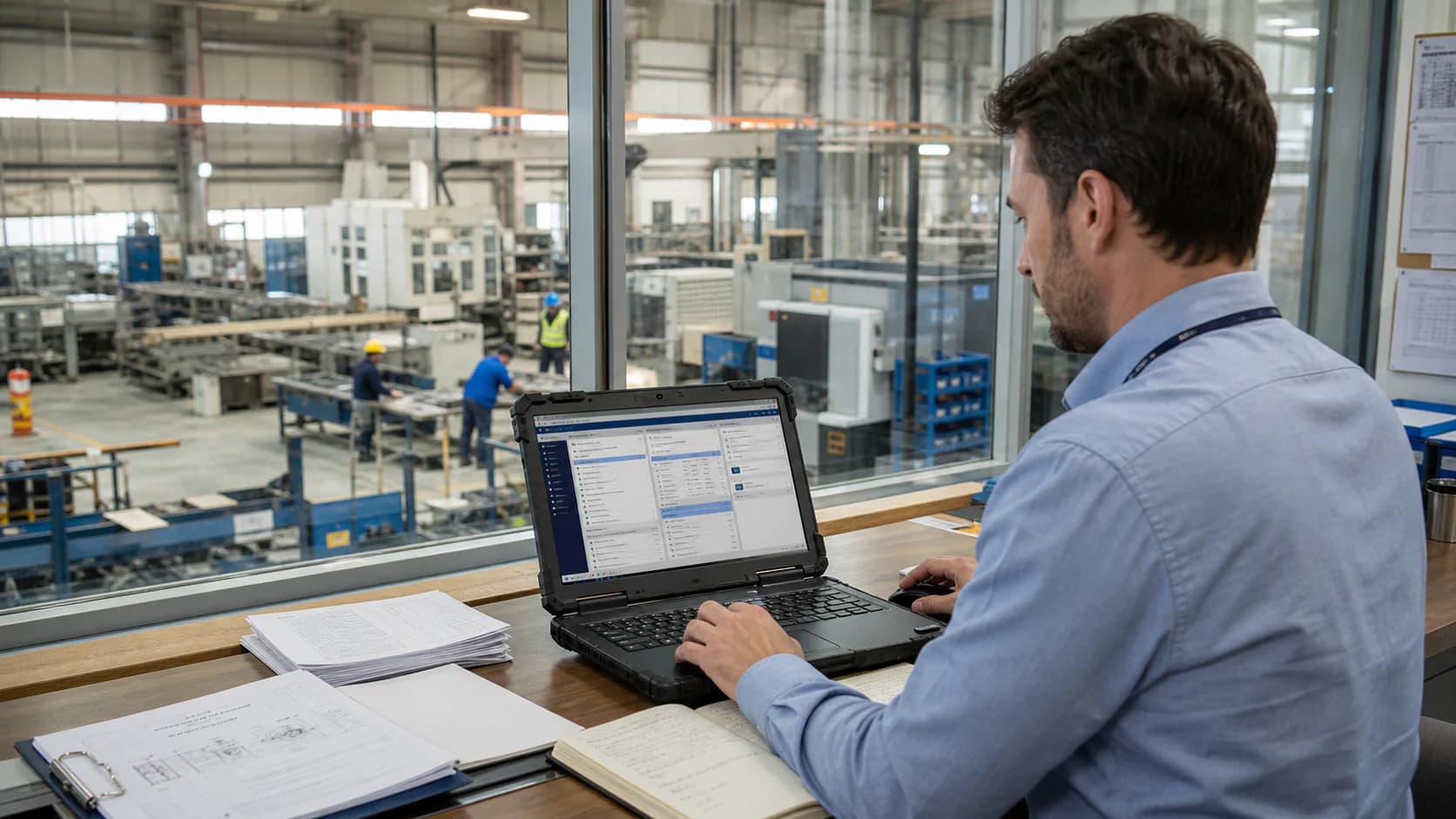
Manufacturing work combines repeatable communication with decisions that require technical and commercial expertise. That makes it a strong setting for bounded AI employees: automate preparation, retrieval, routing, and follow-up while keeping specifications, quality decisions, pricing, and exceptional commitments with people.
The best first workflow is usually the one creating the most repeated coordination work.
1. Prepare routine enquiry replies
An Inbox Coordinator can check incoming sales or customer messages, retrieve approved documents, and prepare replies for review.
| Suitable preparation | Human-owned decision |
|---|---|
| Acknowledge an enquiry | Confirm whether the opportunity is commercially suitable |
| Attach current product sheet | Approve non-standard technical claims |
| Explain published delivery process | Promise an exceptional date |
| List information needed for a quote | Set price, margin, and terms |
| Route a safety or quality concern | Decide corrective action |
This is particularly useful during peak demand when specialists should spend time on exceptions rather than searching for attachments.
2. Check whether required documents are present
Quote and technical enquiries may arrive with drawings, specifications, product codes, quantities, delivery locations, or certification requirements.
An AI employee can identify whether the expected information appears to be present and prepare a clarification request when it is missing. It should not interpret an unsupported engineering file or confirm manufacturability without the appropriate owner.
Document preparation can be automated. Engineering acceptance remains an engineering decision.
3. Answer public product and process questions
A website Customer Service Agent can answer from a public-safe knowledge set:
- Product families and published applications.
- Standard certifications.
- Regions served.
- How to request a quote.
- Public warranty and support routes.
- Available technical documents.
Sensitive quality complaints, safety reports, custom specifications, and account-specific questions should move to a person.
4. Research distributors and buyers
The Sales Development Employee can research companies that match a written market brief.
| Research field | Manufacturing example |
|---|---|
| Geography | Approved expansion markets |
| Company role | Distributor, OEM, integrator, or service partner |
| Product relevance | Public catalog or application match |
| Evidence | Official product, partner, and location pages |
| Contact reliability | Published business route on official domain |
| Exclusions | Competitors, current customers, unsuitable segments |
The output should explain fit with sources, not merely list names. See the AI lead research guide for the complete evidence model.
5. Follow up on quotes and technical conversations
After the team sends an approved reply, a Lead Follow-Up employee can track whether another response is expected.
Examples include:
- Customer has not provided a missing drawing.
- Distributor has not confirmed a meeting.
- Prospect has not responded to an approved introduction.
- Quote recipient has not acknowledged receipt within the agreed window.
The system should pause when a reply arrives, stop on opt-out, and avoid automatic pressure around complex procurement timelines.
An illustrative connected workflow
A manufacturer receives an enquiry for forty customized units.
- The Inbox Coordinator detects a direct commercial enquiry.
- It finds the relevant standard product sheet.
- It identifies that a required drawing and target date are missing.
- It prepares an acknowledgement and clarification request.
- A sales engineer reviews and sends the reply.
- The conversation enters waiting because the customer needs to provide information.
- If no reply arrives after the approved delay, a contextual follow-up is prepared.
- Once information arrives, the technical and commercial owners make the real quote decision.
The AI employees coordinate the routine path. They do not decide whether the custom unit can be produced.
Knowledge to prepare
| Source | Owner |
|---|---|
| Product and application summaries | Product management |
| Current technical documents | Engineering or quality |
| Standard lead-time guidance | Operations |
| Quote intake requirements | Sales operations |
| Warranty and return policy | Quality and commercial teams |
| Approved reply examples | Sales leadership |
| Sensitive-topic map | Operations, quality, legal, and security owners |
Measure a manufacturing pilot
Track preparation time, document completeness, approval edits, escalation reasons, missing-knowledge events, and follow-ups completed. Do not claim production savings from an email workflow unless production measures actually support it.
Explore Steadframe's manufacturing industry guide, Inbox Coordinator, and Sales Development Employee to assemble a workforce around the real bottleneck.