What's a Good Email Response Time for a Business? Benchmarks and How to Hit Them
Customers now expect replies within hours. Here are the benchmarks that matter, why speed wins deals, and five practical ways to hit them without hiring.
Ask business owners how fast they answer email and most say "same day, usually." Ask their customers, and a different picture appears: research on customer service expectations consistently finds that a large majority of people expect a response within a few hours — and a meaningful share expect one within one hour. Meanwhile, the average business reply still takes longer than a working day.
That gap is where deals quietly die. The first supplier to answer usually feels like the most competent one, whether or not that's true.
What the benchmarks actually look like
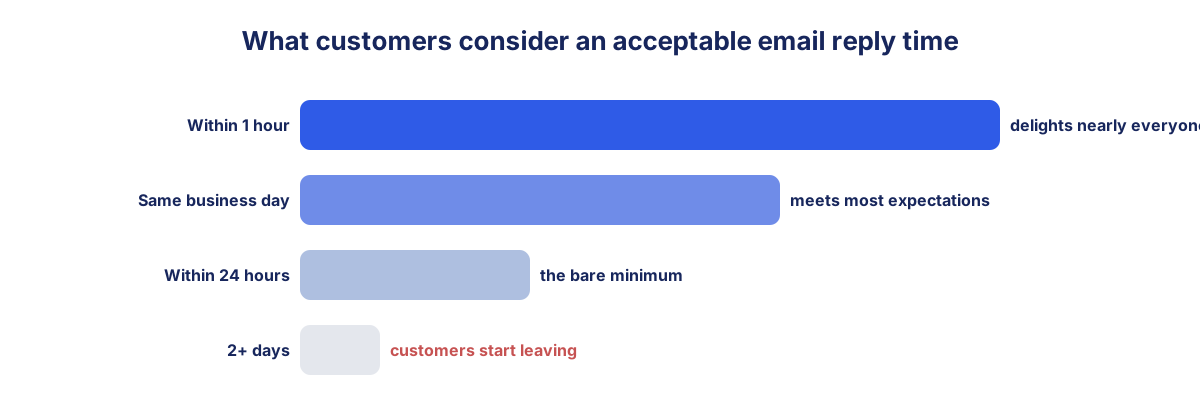
Reasonable targets by message type, drawn from common industry benchmarks:
| Message type | Good | Acceptable | Losing business |
|---|---|---|---|
| New sales enquiry | Under 1 hour | Same business day | Next day or later |
| Existing customer question | Under 4 hours | Same business day | 48 hours |
| Support issue | Under 2 hours | Same business day | 24+ hours |
| Supplier / partner mail | Same day | Next business day | 3+ days |
Two patterns are worth internalizing. First, new enquiries are the most perishable — an interested buyer may be comparing several options right now, and speed itself is a signal of how you'll treat them as a customer. We explain how to choose and measure a realistic response target in the lead-response-time guide. Second, consistency beats occasional heroics: replying in ten minutes on Tuesday and three days on Friday reads as unreliable.
Why small teams struggle to hit these numbers
It isn't laziness — it's arithmetic. A team of three handling 60 inbound emails a day, at an average of six minutes per reply, is spending six working hours daily on email. Nobody was hired to do that, so email happens between "real work," in batches, late. Batching is efficient for the writer and terrible for the customer waiting since 9:14 AM.
Five ways to get faster without hiring
- Triage automatically. Route mail into urgent / action / FYI / noise buckets so the messages that need speed are seen first. Our guide to AI email triage covers the standard four-bucket setup.
- Kill the blank page. Most reply time is spent starting. Pre-written drafts — whether templates or AI-generated ones grounded in your price lists and policies — cut a six-minute reply to a sixty-second review.
- Set an honest auto-acknowledgement. "We've got your message and will reply before 5 PM" buys goodwill, if you then actually do.
- Assign ownership. Shared inboxes fail when everyone assumes someone else will answer. One owner per category, visible to the team — more on this in fixing shared inbox problems.
- Let software watch the clock. An AI employee that checks the inbox every minute and prepares a grounded draft turns your response time into "however fast a human can read and click send." Steadframe's Inbox Coordinator works exactly this way — drafts in minutes, humans keep the final word.
Measure it, or it won't improve
Pick one number: median time to first reply during business hours. Check it weekly. Most teams that start measuring discover their true median is two or three times worse than their gut feeling — and most teams that automate drafting cut it by 60–80% in the first month.
Speed isn't about typing faster. It's about removing the waiting time between "email arrives" and "someone starts the reply." Fix that step and the benchmarks above stop being aspirational.